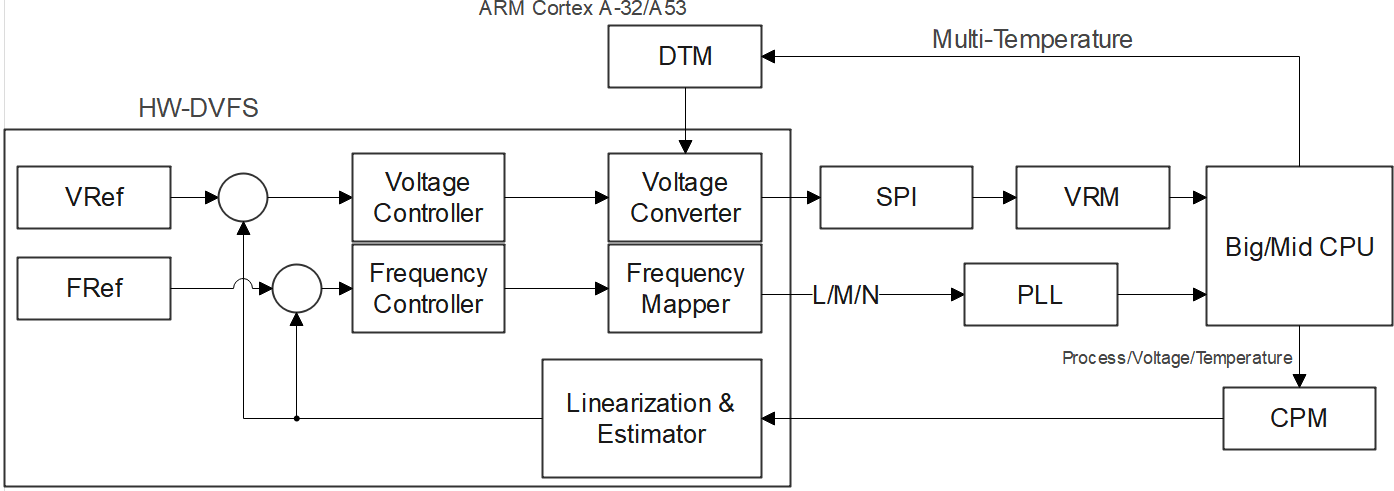
Efficient power management is crucial for optimizing the performance and energy consumption of a CPU. This post delves into the various components involved in CPU power management and their interactions, as illustrated in the accompanying block diagram.
Key Components
- Voltage Reference (VRef): This component provides a reference voltage signal that helps set the target voltage level for the system.
- Frequency Reference (FRef): This component offers a reference frequency signal, used to establish the target frequency level for the system.
- Voltage Controller: Utilizing the VRef and other input signals, the voltage controller sets and regulates the appropriate voltage.
- Frequency Controller: Using the FRef and additional input signals, the frequency controller sets and regulates the appropriate frequency.
- Linearization & Estimator: This component compensates for system non-linearities and estimates various parameters to maintain optimal performance.
- Dynamic Voltage and Frequency Scaling (DVFS): DVFS dynamically adjusts the CPU's voltage and frequency to balance power consumption and performance efficiently.
- Dynamic Thermal Management (DTM): DTM detects temperature changes and manages the thermal state of the CPU, ensuring it operates within safe temperature ranges.
- Voltage Regulator Module (VRM): VRM supplies the actual voltage to the CPU as determined by the DVFS.
- Phase-Locked Loop (PLL): PLL generates a stable frequency as determined by the DVFS and supplies it to the CPU.
- Central Processing Unit (CPU): The CPU executes computing tasks, with its performance and power efficiency managed by the surrounding components.
- Critical Path Monitoring (CPM): CPM monitors and reports the state of processes, voltage, and temperature, providing crucial data for system adjustments.
Interactions Explained
- VRef to Voltage Controller: The voltage reference signal is sent to the voltage controller to help set the target voltage.
- FRef to Frequency Controller: The frequency reference signal is sent to the frequency controller to help set the target frequency.
- Voltage Controller to DVFS (Voltage): The voltage set by the voltage controller is passed to the DVFS for further adjustments.
- Frequency Controller to DVFS (Frequency): The frequency set by the frequency controller is passed to the DVFS for further adjustments.
- DVFS (Voltage) to VRM: The voltage determined by the DVFS is sent to the VRM, which then supplies this voltage to the CPU.
- DVFS (Frequency) to PLL: The frequency determined by the DVFS is sent to the PLL, which then supplies this frequency to the CPU.
- VRM to CPU: The VRM supplies the determined voltage to the CPU.
- PLL to CPU: The PLL supplies the determined frequency to the CPU.
- DTM to DVFS: The DTM sends temperature information to the DVFS, enabling it to adjust voltage and frequency based on thermal conditions.
- CPU to CPM: The CPU provides state information (process, voltage, temperature) to the CPM.
- CPM to Linearization & Estimator: The CPM sends collected data to the Linearization & Estimator for system performance estimation and correction.
- Linearization & Estimator to DVFS: The estimated performance data is sent to the DVFS, aiding in the adjustment of voltage and frequency settings.
- DTM to Multi-Temperature: The DTM exchanges various temperature information, ensuring comprehensive thermal management.
The Voltage Reference (VRef) provides a reference voltage, while the Frequency Reference (FRef) provides a reference frequency. These reference signals are used by the Voltage Controller and Frequency Controller, respectively, to set and regulate the appropriate voltage and frequency levels.
The Dynamic Voltage and Frequency Scaling (DVFS) component dynamically adjusts the CPU's voltage and frequency based on the inputs from the Voltage and Frequency Controllers. The Dynamic Thermal Management (DTM) manages the thermal state of the CPU by detecting temperature changes and providing temperature information to DVFS.
The Voltage Regulator Module (VRM) supplies the actual voltage to the CPU as determined by the DVFS, while the Phase-Locked Loop (PLL) generates and supplies a stable frequency to the CPU.
The Central Processing Unit (CPU) executes computing tasks, and its state information (process, voltage, temperature) is monitored and reported by the Control Performance Monitoring (CPM). This information is then sent to the Linearization & Estimator to compensate for system non-linearities and estimate performance parameters, which in turn adjust the settings via DVFS.
In summary, VRef and FRef signals are input to the Voltage and Frequency Controllers, which pass their settings to DVFS. DVFS sends the determined voltage to VRM and the frequency to PLL. VRM supplies the voltage, and PLL supplies the frequency to the CPU. DTM provides temperature information to DVFS, while the CPU reports its state information to CPM. CPM sends data to the Linearization & Estimator, which adjusts settings through DVFS, ensuring optimized performance and energy efficiency.
'IT' 카테고리의 다른 글
| Chip Testing and Binning for DVFS Implementation (1) | 2024.08.01 |
|---|---|
| Power-on Reset Sequence (3) | 2024.08.01 |
| Implementing DVFS (Dynamic Voltage and Frequency Scaling) on an Android phone (1) | 2024.08.01 |
| Clock Generator in Critical Path Monitor (CPM) (0) | 2024.08.01 |
| 저전력 시스템에서 슬립 트랜지스터 설계 시 고려 사항 (2) | 2024.08.01 |